Written by HawaiiNewsHoku Staff Writer
As the 2026 legislative session begins, Hawaiʻi lawmakers have already introduced a proposal that is drawing sharp criticism from gun owners, civil liberties advocates, and residents who are questioning its logic.
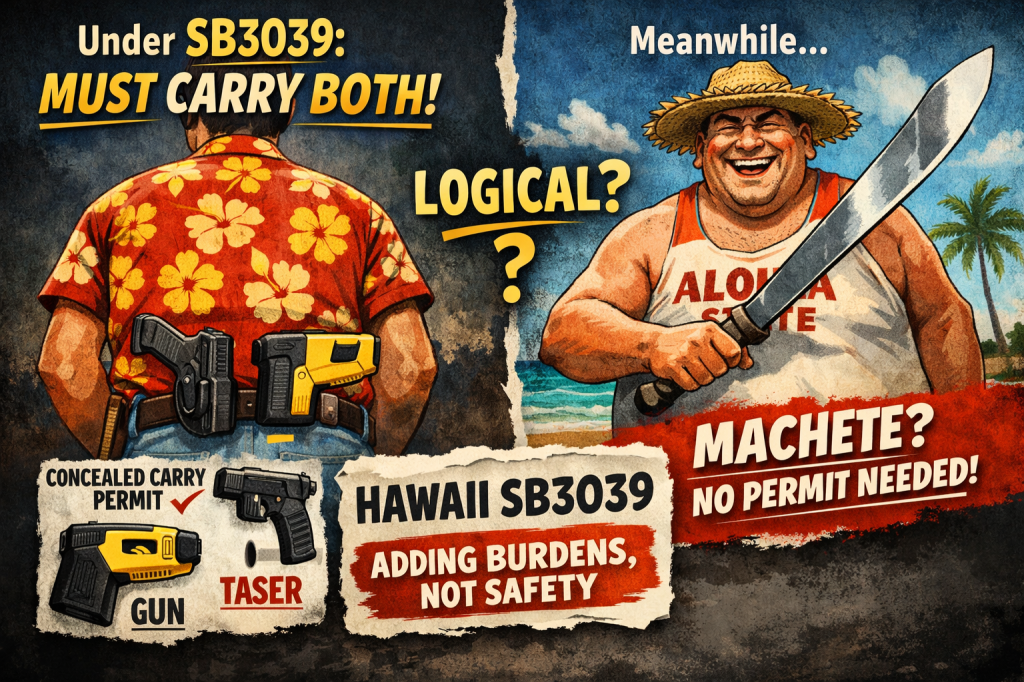
The bill, SB3039, would require anyone who is legally carrying a firearm under a concealed carry license to also carry a taser at all times. Supporters of the measure say it is meant to improve public safety by ensuring that armed individuals have a “less-lethal” option available.
But the reasoning behind the bill, and its practical effect, are being widely challenged.
In the bill’s findings, lawmakers argue that firearms carried for self-defense often increase danger, claiming they are frequently used against the person carrying them or cause harm to bystanders. The language suggests that a gun as the “only means of defense” creates unnecessary risk.
Critics say that logic collapses under basic scrutiny. If a firearm is considered too dangerous to be carried alone, they argue, forcing someone to carry a second weapon does not reduce risk. Instead, it adds complexity, confusion, and new legal exposure for people who are already following the law.
The bill also stands in contrast to other legal realities in the state. In Hawaiʻi, it is legal to openly carry large bladed tools, including machetes, without a permit, training, or background check. Meanwhile, individuals who carry concealed firearms must already pass background checks, fingerprinting, training requirements, and licensing reviews.
For many residents, that contradiction highlights what they see as an uneven and inconsistent approach to public safety.
Opponents of SB3039 argue that the bill’s true effect would be to create additional barriers for lawful gun owners. They say that requiring extra equipment opens the door to technical violations, such as forgetting the taser, having a dead battery, or being unable to afford the device, all of which could jeopardize a person’s license even if no harm has occurred.
They also note that the bill refers broadly to “data” without citing specific studies, raising concerns about whether the proposal is driven by evidence or ideology.
Supporters of the bill have said it encourages the use of less-lethal force and could help prevent deadly outcomes. However, critics counter that responsible gun owners already understand the gravity of using a firearm and that safety comes from training, judgment, and accountability, not from forcing people to carry more weapons.
As more firearm-related bills are expected to be introduced before the January 28 deadline, SB3039 is likely to be closely watched. Whether it moves forward or not, it has already sparked a larger debate about how Hawaiʻi balances constitutional rights, public safety, and practical policy.
At its core, the question raised by SB3039 is a simple one: does adding another weapon truly make people safer, or does it simply make compliance more difficult for those who are already obeying the law?
Written by HawaiiNewsHoku Staff WriterAs the 2026 legislative session begins, Hawaiʻi lawmakers have already introduced a proposal that is drawing sharp criticism from gun owners, civil liberties advocates, and residents who are questioning its logic. The bill, SB3039, would require anyone who is legally carrying a firearm under a concealed carry license to also carry…
Discover more from HawaiiNewshoku
Subscribe to get the latest posts sent to your email.




Leave a comment