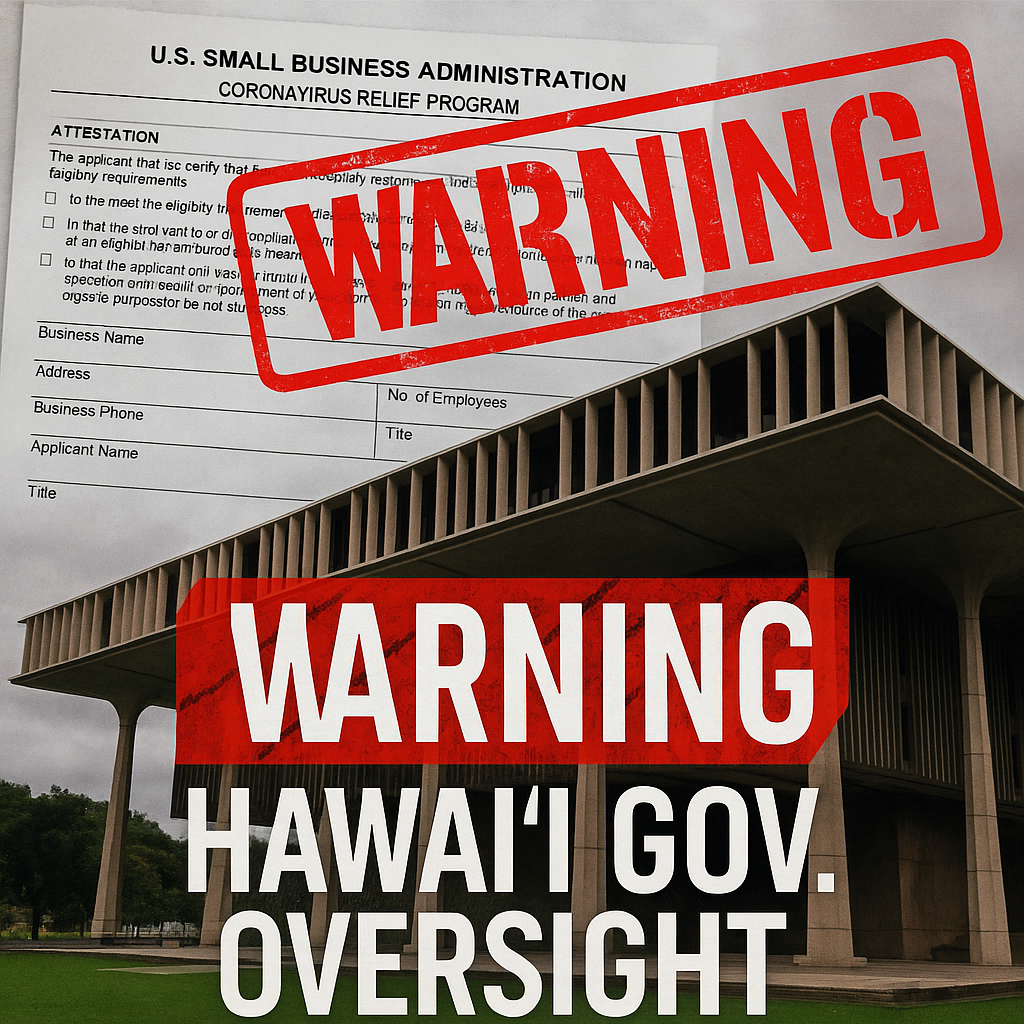
A major federal investigation unfolding in Minnesota has exposed what officials call one of the most brazen COVID-relief fraud networks in the country. According to the video report now circulating online, a series of Somali-linked organizations allegedly channeled millions in pandemic aid through shell companies while top state Democrats looked the other way or benefited politically from the arrangement.
Whether those allegations ultimately hold up in court is for investigators to decide, but the implications extend far beyond Minnesota. For Hawaiʻi, a state that received billions in federal pandemic funding and already struggles with transparency issues, this scandal should ring louder than a conch shell on election year.
Why Hawaiʻi Should Be Paying Attention
Hawaiʻi is not Minnesota, but the structural weaknesses revealed in the mainland investigation mirror long-standing concerns here at home. The allegations raise familiar questions:
Who gets access to federal aid in Hawaiʻi?
How much political influence shapes those decisions?
How strong are oversight systems when billions in emergency funds flood the islands?
Hawaiʻi’s government has faced repeated criticism for its slow disclosure of spending, from CARES Act allocations to emergency procurement during the pandemic. The state auditor has repeatedly clashed with agencies over missing documentation and inconsistent reporting. If fraud on the Minnesota scale were attempted here, would Hawaiʻi’s systems catch it or accidentally usher it in with a friendly shaka?
Vulnerabilities in Hawaiʻi’s Aid Distribution
Emergency aid tends to flow fast, and in Hawaiʻi, speed has often replaced oversight. Consider:
The state used expedited no-bid contracts for everything from contact tracing to PPE distribution.
Millions were rushed into nonprofit grants with little follow-up on measurable outcomes.
Several municipalities struggled to track who truly qualified for rent and small-business relief.
Minnesota’s scandal shows how quickly fraudulent networks can form when urgency meets weak guardrails. Hawaiʻi’s complex web of nonprofits, political alliances, and grant-funded community groups could be equally vulnerable if systems remain unchanged.
The Political Dimension in Hawaiʻi
Minnesota’s uproar is not just about money. It is about political proximity. The video points directly at top Democratic leaders and their relationships with aid-receiving organizations.
Sound familiar?
Hawaiʻi’s political ecosystem is famously small. Many nonprofits rely on state legislators for recurring funding. Many legislators rely on those same nonprofits for voter outreach, cultural influence, or community visibility. When funding relationships double as political relationships, tight-knit communities can accidentally begin to look like closed circles.
The question becomes sharper:
Could a similar aid-distribution scandal happen in Hawaiʻi simply because everyone knows everyone?
Hawaiʻi’s Unique Cultural Layer
While Minnesota’s case centers on Somali immigrant networks, Hawaiʻi has its own culturally defined community groups that often serve as intermediaries for government funding:
Hawaiian-serving organizations
Pacific Islander programs
Asian immigrant support networks
Local cultural associations
Faith-based community partners
These groups do vital work. But any system that funnels money through cultural organizations requires strong oversight to protect both taxpayers and the communities themselves from reputational harm.
Hawaiʻi cannot afford a scandal that smears entire cultural groups because of the actions of a small number of opportunists.
Lessons for Hawaiʻi’s Government
Minnesota’s mess should be treated as a blueprint for prevention in the islands. Key takeaways include:
1. Audit everything. Hawaiʻi’s auditor needs more teeth, not more pushback from agencies.
2. Publish real-time spending data. Transparency should not arrive years later as a PDF buried on a state website.
3. Separate political influence from nonprofit funding. Community relationships are not a substitute for accountability.
4. Increase fraud safeguards for emergency aid. The next disaster will come. Fraudsters plan farther ahead than governments do.
5. Protect cultural groups by protecting the integrity of their funding. Oversight is not discrimination. It is defense.
Why This Matters to the People of Hawaiʻi
Hawaiʻi residents are already battling record-high costs of living, unstable housing availability, and government programs that often feel slow or uneven. When relief funds fail to reach real families, trust erodes. When politically connected groups receive preferential treatment, public faith in democracy cracks.
Minnesota’s scandal is a warning shot.
Not because Hawaiʻi is guilty of the same behavior, but because the same vulnerabilities exist here, amplified by our small population and interconnected political culture.
If Hawaiʻi wants a future where relief funds actually relieve people, then oversight must be more than an afterthought. It must be the backbone of government spending.
A long-form investigative feature
A series of three articles
A breaking-news style post
A social media teaser for HawaiʻiNewsHoku.org
Just tell me the direction you want next.




Leave a comment