By Hawaiʻi News Hoku Staff Writer
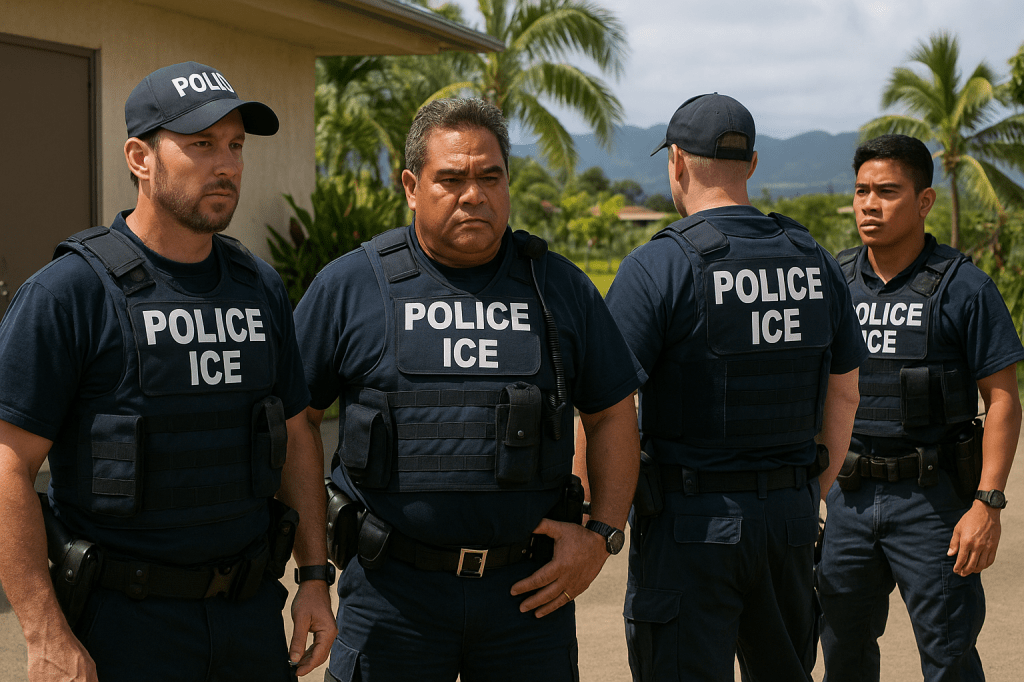
A federal immigration raid on Kauaʻi in early November 2025 targeted employees of Hawaiʻi Care and Cleaning, a company that had agreed to pay $3.8 million in back wages following a U.S. Department of Labor lawsuit earlier this year (Hawaii News Now, 2025). The company was previously fined for misclassifying hundreds of workers as independent contractors to avoid paying overtime and benefits.
This event brings forward one of Hawaiʻi’s toughest and most persistent questions: how can the islands balance compassion with fairness when housing, wages, and basic living costs continue to rise faster than most families can keep up? Immigration and labor enforcement issues are no longer isolated from local economic stress — they are part of the same story about sustainability and accountability.
Quantitative Snapshot:
The data from 2024 to 2025 reveal how closely immigration enforcement and Hawaiʻi’s housing crisis are tied together. According to Civil Beat (2025), ICE administrative arrests jumped from 19 between August 2024 and January 2025 to 117 between January and June 2025, showing a significant rise in federal enforcement activity across the islands. At the same time, the Department of Business, Economic Development & Tourism (2022) reported that roughly 115,000 residents live in overcrowded housing, with 47,000 in severely overcrowded conditions. This situation pushes families to share limited space, often leading to unsafe or unsanitary conditions and growing tension in neighborhoods. USA Facts (2024) noted that about 39 percent of households—roughly 185,900 families—spend more than 30 percent of their income on housing, a key indicator of financial strain. The HiEstates (2025) index places Hawaiʻi’s cost of living at 185 compared to the national average of 100, while Living in Hawaiʻi (2025) reported that the median home price across Oʻahu, Maui, and Kauaʻi has reached approximately $1.5 million. Together, these numbers paint a clear picture: as enforcement increases, the economic stress on both local and immigrant communities continues to reveal deep imbalances between income, housing, and opportunity.
—Enforcement and Accountability
Federal officials confirmed that the Kauaʻi operation involved multiple agencies and was part of a larger criminal investigation. Immigration attorney Gary Singh said that after a company receives a major federal labor fine, it is common for immigration enforcement to follow (Hawaii News Now, 2025).This connection between labor enforcement and immigration oversight is important because it underscores how one broken law can lead to another. When companies skirt wage rules, they often rely on labor arrangements that are off the books. Those same gaps make it easier for exploitation to occur and harder for lawful workers to compete. In everyday terms, that means local residents end up paying the price — whether through fewer available jobs, higher rents, or longer waits for affordable housing. In small island economies like Hawaiʻi’s, fairness depends on compliance, not shortcuts.
—Economic Pressures and Housing Reality
The Department of Business, Economic Development & Tourism (2022) reports that more than 115,000 residents live in overcrowded housing, and 47,000 live in severely overcrowded conditions.This statistic shows how stretched the housing system has become. Many families double up in small units just to make rent, often sharing space with extended relatives or friends. In some cases, as locals say, “twenty people to one roof.” These living conditions can create fire hazards, sanitation issues, and tensions with neighbors, but they also reveal how unaffordable the market has become for working-class residents. When overcrowding rises this high, it signals a deeper imbalance between income and housing supply — and why accountability in both labor and property markets matters.
Housing costs remain extreme: the cost-of-living index sits around 185, and the median home price across Oʻahu, Maui, and Kauaʻi hovers near $1.5 million (HiEstates, 2025; Living in Hawaiʻi, 2025).These numbers are more than statistics — they reflect the daily strain local families feel when wages stay stagnant while property prices and rent rise faster than inflation. For many, even a two-income household struggles to break even. Hawaiʻi’s culture of hospitality and openness is strong, but rising costs have made it difficult for residents to maintain that same spirit when economic survival feels uncertain. The Kauaʻi raid, though controversial, becomes part of that larger conversation about who gets access to limited housing and resources.
—Immigration, Community, and Lawfulness
Hawaiʻi’s foreign-born population is approximately 18.6 percent, compared to 14.8 percent nationally (USA Facts, 2024). Around 42,000 individuals are estimated to be undocumented, with about one-quarter living in mixed-status families (Migration Policy Institute, 2024).These figures illustrate that immigration is woven deeply into Hawaiʻi’s social fabric. Many newcomers contribute meaningfully to local industries like hospitality, construction, and care work. Yet, the system’s lack of oversight can create unfair advantages for businesses that ignore labor laws.
Locals who play by the rules — paying taxes, meeting permit requirements, and struggling to afford housing — often feel left behind.
Upholding lawfulness ensures that those contributing legally are not undercut by employers exploiting cheap or unregulated labor.In simple terms, accountability supports both compassion and fairness. Protecting workers from abuse and protecting the economy from distortion are two sides of the same coin. When immigration laws and labor laws align, both residents and lawful immigrants benefit from a more stable and transparent system.
—Local Reflection: Balancing Aloha with Responsibility
On Kauaʻi, reactions to the raids have been mixed. Some residents express sympathy for those detained, while others see the action as overdue. A resident in Līhuʻe summarized the mood: “We feel bad for anybody struggling, but rules gotta mean something. We all trying to survive here, and if the system stay broken, nobody can.”This sentiment captures the ongoing challenge Hawaiʻi faces — balancing aloha with accountability. Compassion is not weakness; it is a value best upheld when fairness is consistent. Lawfulness keeps communities safe, but empathy keeps them connected. When the two work together, Hawaiʻi’s people — locals and newcomers alike — can share in a sense of collective responsibility that honors both heart and rule.
—References
Civil Beat. (2025, July). Immigrant arrests rise in Hawaiʻi; political leaders condemn ICE tactics. https://www.civilbeat.org/2025/07/immigrant-arrests-rise-hawaii-political-leaders-condemn-ice-tactics
Department of Business, Economic Development & Tourism (DBEDT). (2022). Overcrowding in Hawaiʻi housing. https://files.hawaii.gov/dbedt/economic/reports/Overcrowding_in_Hawaii_Housing.pdf
Department of Homeland Security. (2025, May 12). ICE arrests “worst of the worst” criminal aliens in Hawaiʻi. https://www.dhs.gov/news/2025/05/12/ice-arrests-worst-worst-criminal-aliens-hawaii
Hawaii News Now. (2025, November 6). Immigration raid targets cleaning company employees months after wage settlement. https://www.hawaiinewsnow.com
HiEstates. (2025). Cost of living in Hawaiʻi. https://www.hiestates.com/blog/cost-of-living-in-hawaiiLiving in Hawaiʻi. (2025). Cost of living in Hawaiʻi: 2025 update. https://www.livinginhawaii.com/cost-of-living-in-hawaii-2024
Migration Policy Institute. (2024). Unauthorized immigrant population in Hawaiʻi. https://www.migrationpolicy.org/data/unauthorized-immigrant-population/state/
HIUSA Facts. (2024). Housing cost burden in Hawaiʻi. https://usafacts.org/answers/how-many-households-in-the-united-states-spend-too-much-on-housing/state/hawaiiUSA Facts. (2024). Immigrant population in Hawaiʻi. https://usafacts.org/answers/how-many-immigrants-are-in-the-us/state/hawaii




Leave a comment