By Hawaii News Hoku Staff Writer
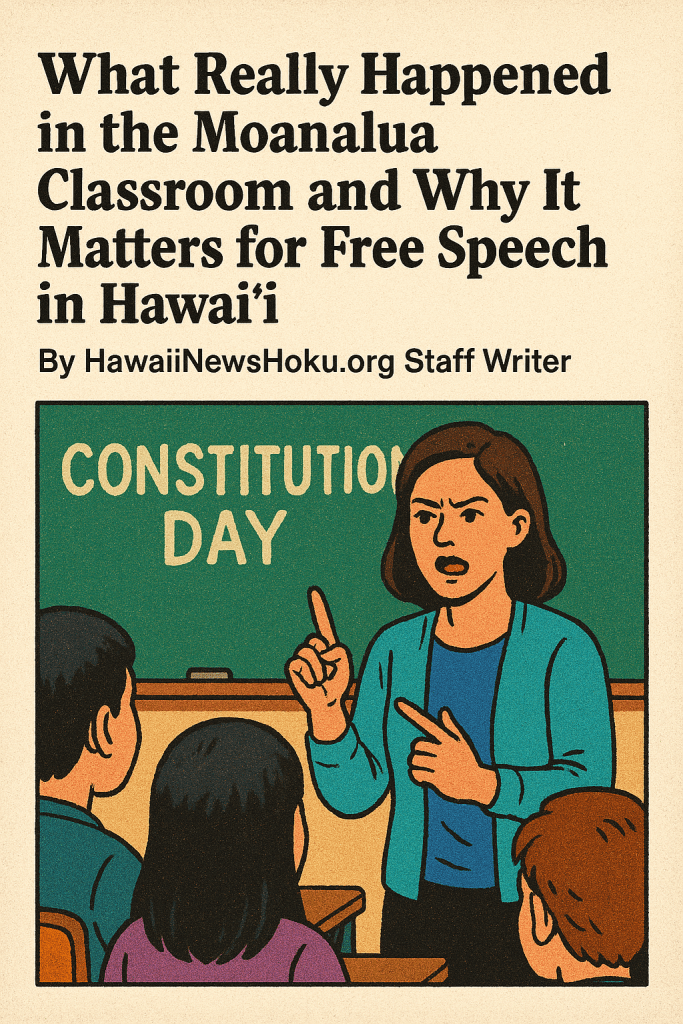
It began as a Constitution Day civics lesson, a federally required class activity about the Bill of Rights. The Moanalua Middle School teacher had planned a discussion on the First Amendment, with notice already given to parents. What came next sparked a statewide debate over classroom speech, free expression, and how far the Department of Education should go in policing conversation.
During the lesson, one student mentioned conservative commentator Charlie Kirk, saying something like, “He was killed for his speech.” Other students joined in and named historical figures such as Martin Luther King Jr., Abraham Lincoln, and John F. Kennedy, all assassinated because of their beliefs. The class was engaged, thinking deeply about what “freedom of speech” really means.
Then came the moment that changed everything. A student brought up an attempted attack on former President Donald Trump, and another said quietly, “That wouldn’t be so bad.” The teacher immediately stopped the talk and said, “You can’t kill people because you disagree with their speech. Calls for violence are not protected speech.” In that instant, she modeled exactly what the First Amendment is meant to teach: how to handle disagreement without hate.
Later that same day, the vice principal interrupted a department meeting and told teachers they could not allow controversial issues to come up in class without prior approval or parent notification. The teacher was called in and handed a memo warning that any future “spontaneous” discussions could lead to disciplinary action. The memo read, “If controversial issues arise spontaneously without administrative approval and parent notification, discussion must be stopped immediately.” It was placed in her personnel file. To many in the school, it looked like punishment for doing her job.
After the American Center for Law and Justice (ACLJ) stepped in, the Hawaiʻi Department of Education issued a letter on November 6, 2025, confirming that no disciplinary action was taken and that the teacher remained in good standing. Superintendent Keith Hayashi signed the response, citing Board of Education Policy 101-13, which explains how teachers should handle controversial topics. The department stopped short of admitting any wrongdoing, but its retreat made one thing clear: teachers should not be afraid to teach the Constitution or correct dangerous comments in class.
Policy 101-13 was written to keep lessons balanced, not to silence teachers. Yet, more often than not, it is being used to shut down open dialogue, especially when conservative viewpoints are mentioned. In this case, a teacher’s fair and calm response to a violent comment somehow triggered a bureaucratic warning instead of support. That sent a chill across classrooms on Oʻahu and beyond. Teachers were left wondering if they could still talk story about real issues without risking a complaint.
This whole situation shows how fragile freedom in the classroom has become. Teachers are told to encourage critical thinking but are punished the moment a student’s comment crosses a line someone in administration finds uncomfortable. The DOE’s quiet walk-back, after national attention, proves that common sense and fairness can still win out. Free speech is not about politics. It is about community, respect, and learning to disagree without fear. When people in power need outside pressure to remember that, something is wrong in the system.
Editor’s Note: At HawaiiNewsHoku.org, we believe Hawaiʻi’s classrooms should be places of honest discussion and mutual respect. Our job is to shine light on how local policies affect the real people of these islands: the teachers, parents, and keiki who live with the outcomes. Freedom of speech is not a mainland idea. It is a Hawaiian value too, rooted in aloha, truth, and courage. When red tape or politics silence that freedom, everyone loses. We encourage the people of Hawaiʻi to read the full Board of Education Policy 101-13 and decide if it truly lives up to its purpose. Real transparency and accountability are what keep both education and aloha strong.References:Hawaiʻi DOE Response Letter to ACLJ (Nov. 6, 2025).ACLJ Demand Letter to HIDOE (Oct. 16, 2025).Hawaiʻi Free Press (Nov. 3, 2025). Hawaii DOE Disciplines Teacher for Student-Initiated Charlie Kirk Free Speech Discussion on Constitution Day.Hawaiʻi Public Radio (Nov. 4, 2025). Teacher Says DOE Response to Charlie Kirk Class Discussion Violates Her Rights.Board of Education Policy 101-13: Controversial Issues (2021).




Leave a comment